
Key Takeaways
- C. auris spreads fast and survives on surfaces for weeks.
- UV light needs a clear, close path; shadows and distance reduce effectiveness.
- Hydrogen peroxide vapor takes two to four hours and can damage equipment.
- HOCl fogging reaches every surface, with no line-of-sight limits.
- HOCl fogging achieves a 5.9-log reduction against C. auris in two minutes.
The Growing Challenge of C. Auris
In 2023, the CDC called Candida auris an “urgent antimicrobial resistance (AR) threat.” From 2022 to 2024, clinical cases more than doubled nationwide. Cases continue to climb, and more than 1 in 3 patients die within a month of being diagnosed with an invasive C. auris infection.
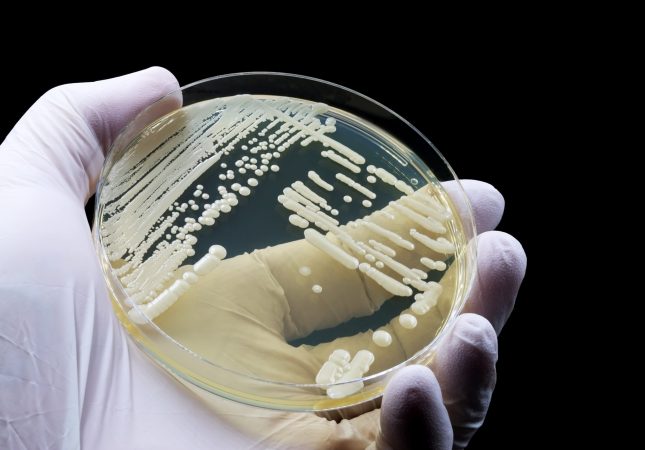
Patients who carry C. auris often shed it onto nearby surfaces. It can live on countertops, bed rails and other equipment for weeks. The fungus is resistant to many standard antifungal treatments, and can come back fast, even after routine cleaning. The CDC’s recommended surface hygiene measures to combat C. auris include using an EPA-registered hospital-grade disinfectant.
It’s crucial that the disinfectant is not only EPA-registered, but can efficiently and effectively reach every surface in the hospital room, consistently, every time. Let’s look at how four common disinfection methods stack up against C. auris: UV-C, hydrogen peroxide vapor, manual wipes, and HOCl fogging.
How Well Does UV-C Kill C. Auris?
Exposure time and distance significantly affect how well UV-C kills C. auris. An independent peer-reviewed study tested UV-C’s effectiveness against C. auris at different times and distances. The strongest kill happened at 30 minutes, from only two meters away. When the time was cut to 15 minutes, the effectiveness dropped around tenfold. When the distance was doubled, the effectiveness plummeted nearly fiftyfold.
Distance matters in a hospital room, where various surfaces are located at different distances from the UV device. UV-C is limited by the inverse square law: effective intensity is reduced 75% as distance from an emitter is doubled. Getting even coverage across every part of the room is difficult and time consuming, requiring repositioning the unit and running multiple cycles to get effective coverage.
Shadows are another shortcoming of UV disinfection, as noted by the FDA in a recent panel discussing UV-C disinfection in hospitals. It requires line of sight to be effective, and can’t bend around a bed, cart or curtain. Objects that block the light create shadows that are not disinfected by the UV light. Achieving even coverage across every part of the room is difficult, if not impossible.
For these reasons, the FDA has classified UV disinfection as an adjunct tool only, rather than a primary or stand-alone solution. Notably, the FDA only requires UV-C devices to show a 2-log reduction (about 99%) to gain clearance, based on the first UV-C device to be classified, which set the standard. Compare that to the regulatory standards for EPA-registered disinfectants, which must achieve a minimum 5-log reduction, or a 99.999% kill rate.
See how FDA and EPA disinfection standards compare, and how UV-C compares to HOCl fogging in a study with S. aureus bacteria.
How Well Does Hydrogen Peroxide Vapor Kill C. Auris?
While hydrogen peroxide vapor can effectively kill C. auris, it can be time consuming. In general, standard EPA-registered hydrogen peroxide solutions require a 10-minute contact time to reach 4- to 6-log reduction, however the total cycle time is much longer. Rooms must be sealed off and aired out afterward in order to allow the peroxide to break down to a safe level.
Cycle times for vaporized hydrogen peroxide are generally around 1.5 to 2.5 hours, while aerosolized hydrogen peroxide requires 2 hours for a single cycle, or 3 to 4 hours for multiple cycles. Some studies cite longer aeration times of up to 5 to 6 hours for hydrogen peroxide vapor.
Hydrogen peroxide vapor can also be corrosive. One study details how exposure to both ionized hydrogen peroxide (iHP) and vaporized hydrogen peroxide (VHP) caused significant material damage. Repeated iHP cycles caused “marked damage” in stainless steel and urethane-, silicone- and epoxy-coating materials, while condensation issues caused “severe damage” to various surfaces.
VHP caused both hardening and softening of resins, discoloration of stainless steel, and bleaching in wooden materials, while condensation caused corrosion in zinc-plated steel, and “severe changes” in metals and resins after repeated exposure.
How Well Do Manual Wipes Kill C. Auris?
The effectiveness of manual wipes against C. auris depends on both the product as well as the person using the wipe. Staff must adhere to precise mixing ratios and physically wipe every surface, including difficult-to-reach corners. Inconsistency and human error are unavoidable.
One study tested 12 wipe-based products against C. auris on hospital surfaces. Half of the products failed to reduce C. auris while 58% failed to stop it from spreading to a new surface during wiping. A whopping 75% failed to stop C. auris from growing back. A separate study found that hydrogen peroxide wipes failed to fully reduce C. auris when soil or grime was present.
Cross-contamination is another glaring shortcoming of manual cleaning. Wiping a surface often simply moves an organism to a different location rather than killing it. Cross-contamination was the cause of the first pediatric cluster of C. auris in the U.S. when improperly disinfected mobile medical equipment was shared between adult and pediatric patients.
How Well Does HOCl Fogging Kill C. Auris?
Independent laboratory testing found that EPA-registered Microburst HOCl achieves an average 5.9-log reduction against C. auris with a two-minute contact time for a kill rate above 99.999%.
Fogging Microburst HOCl also solves many of the shortcomings of UV-C, hydrogen peroxide, and manual wipes. The shadow and distance issue posed by UV is solved as line-of-sight is not required for fogging, which creates a fine mist that reaches every surface directly.
HOCl is non-toxic, pH neutral, and gentle on surfaces, so there’s no need to seal the room or wait for a long chemical breakdown process. Immediate room re-entry is both safe and efficient. Nevoa’s automated fogging technology also provides consistent results every application by removing the potential for human error, variability, and inconsistency.
The Bottom Line
C. auris is a difficult fungus to control. It survives on surfaces, resists many different types of disinfectants, and spreads quickly between patients. UV light needs a clear path and a lot of time to work well. Hydrogen peroxide vapor is effective but slow and can damage equipment. Manual cleaning depends on people physically reaching every spot, every time.
HOCl fogging offers a faster, more complete option, easily reaching surfaces that other methods can miss. Learn more about why Nevoa’s Microburst HOCl solution is the most effective way for hospitals to fight not only C. auris, but a host of other resistant microorganisms.
Frequently Asked Questions
Does UV-C kill C. auris?
Yes, but its effectiveness drops quickly with less time or more distance. Shadows from furniture and equipment can also block the light entirely.
How long does hydrogen peroxide vapor disinfection take?
Most hydrogen peroxide systems require two to four hours per room, including the time to seal and clear the air afterward.
What makes C. auris difficult to kill?
C. auris survives on surfaces for weeks and resists many common disinfectants. Patients also often shed it back onto surfaces after cleaning.
Is HOCl safe to use around hospital equipment?
Yes. Microburst HOCl is pH neutral and less corrosive than bleach, so it will not damage most equipment or finishes.
What’s the fastest way to disinfect a hospital room?
Automated fogging with HOCl offers one of the fastest options, achieving high levels of microbial reduction in just two minutes.